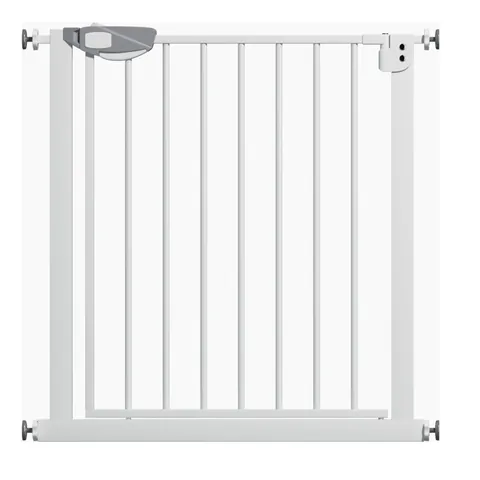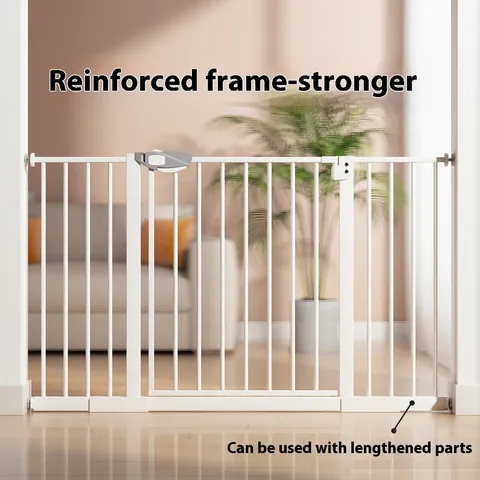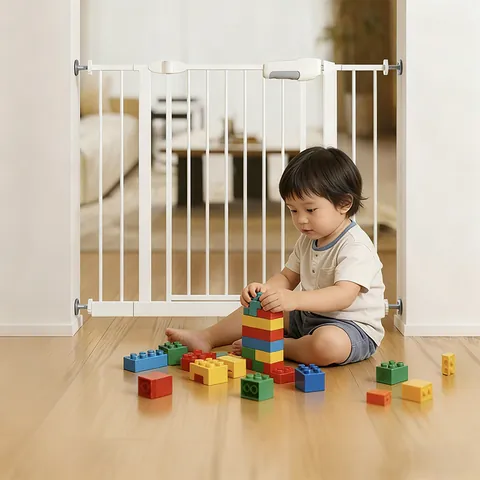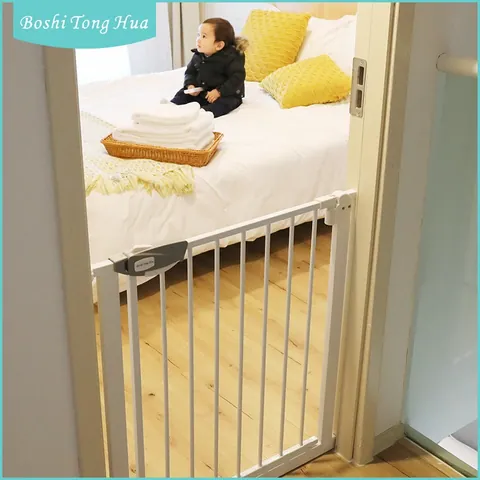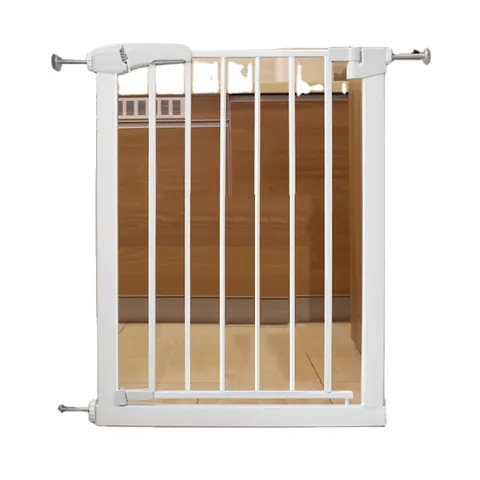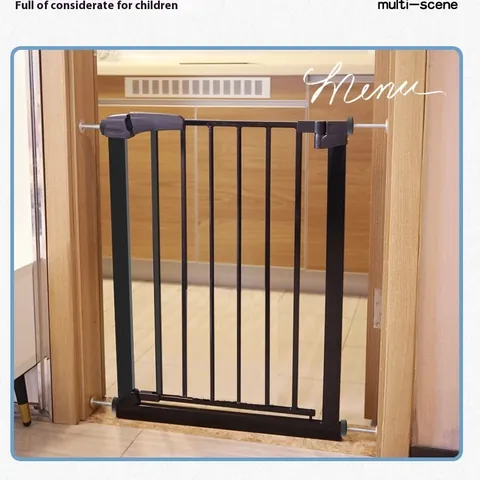
What is the difference?
| Pressure-mounted | Hardware-mounted | |
|---|---|---|
| How it stays in place | Pressure against both sides of the opening | Screws into wall, door frame or banister |
| Installation | No drilling; tightened by hand | Drilling and fixings |
| Moving it | Easy to move between doorways | Stays fixed; brackets remain |
| Renters and marketplaces | "No drilling" is a strong selling point | Sold where a permanent fit is wanted |
| US standard | Both: 16 CFR part 1239 (ASTM F1004); pressure gates also pass a push-out test | |
Where is each type used?
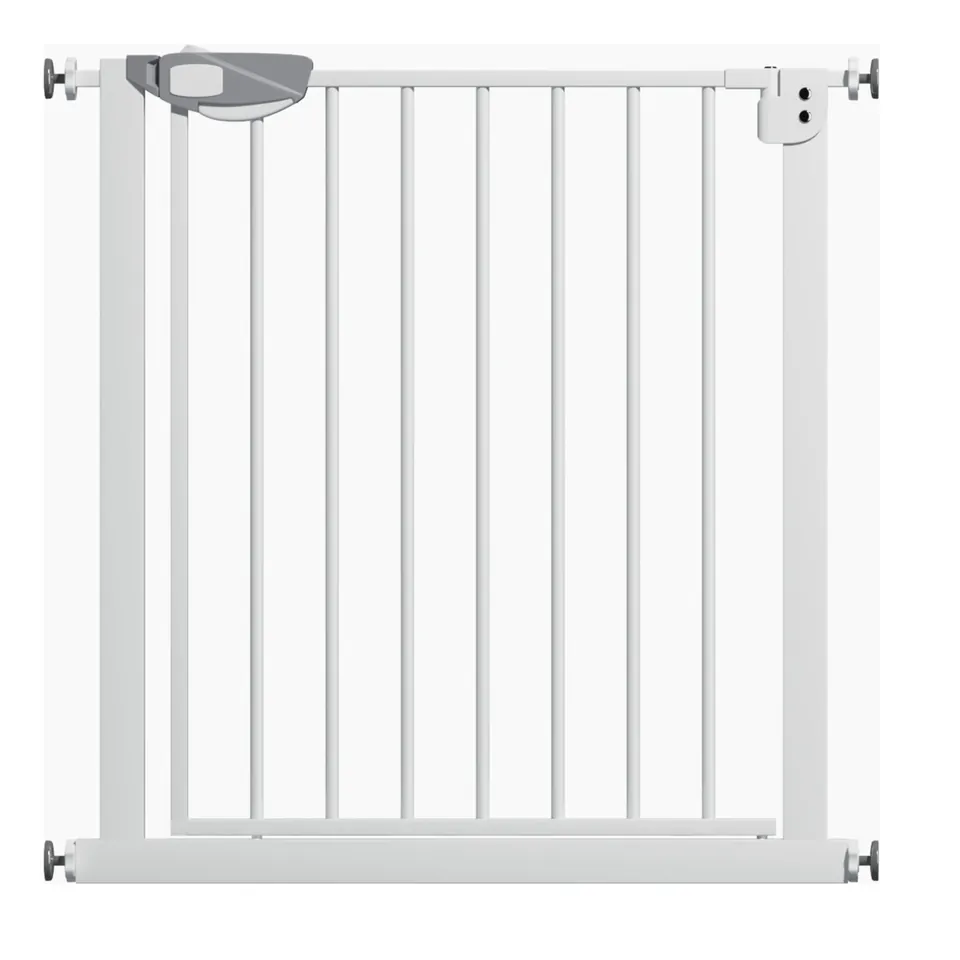
Pressure gates are the usual choice for doorways and hallways because they fit without tools and move from room to room. Hardware-mounted gates are chosen where a fixed, screwed-in gate is wanted. For stairs — especially the top of stairs — the gate's own instructions say which locations it is designed for, and your listing should repeat them.
Which US rule covers baby gates?
Expansion gates and expandable enclosures are covered by 16 CFR part 1239, which incorporates ASTM F1004. The citation for the CPC is "16 CFR part 1239 – Gates and enclosures".
On 1 April 2026 CPSC published a direct final rule updating part 1239 to ASTM F1004-25, effective 19 July 2026 unless withdrawn. CPSC says the 2023 and 2025 revisions do not change the test equipment or protocols. Lab summaries of F1004-25 note one design change: no pet entry or exit openings within the gate or enclosure. If you sell a gate with a built-in pet door as a children's gate in the US, check it against F1004-25 with your lab.
We hold an ASTM F1004 report for our gates; the report number and edition are sent with your quote.

How do extensions change the fit?
A pressure gate fits a range of openings — our catalogue pressure-fit gate fits 77–82 cm and is 76 cm high — and extension pieces widen it for larger openings. Check the widest opening the instructions allow with extensions. For very wide spaces, a foldable freestanding gate made of panels is the alternative to fixing anything to the wall.
Which of our gates install without drilling?
Gates marked Pressure-Fit: Pressure-Fit Baby & Pet Gate, Plastic (PK-114), Pressure-Fit Baby & Pet Gate, Plastic (PK-119), Pressure-Fit Foldable Baby Gate, Metal & Plastic (PK-123). Retractable and foldable freestanding gates also need no drilling — see the baby gate range.
What should the listing say?
- The fitting range without extensions, and the widest opening with the extensions you include.
- The mounting type and whether tools or drilling are needed.
- The locations the instructions allow, word for word.
- The height of the gate and its opening and closing method.
- The standard it was tested to — for the US, 16 CFR part 1239 (ASTM F1004).
Questions to ask any gate supplier
| Question | Why |
|---|---|
| Which edition of ASTM F1004 is the report to? | The US rule moves to F1004-25 from 19 July 2026 |
| What is the fitting range with and without extensions? | The gate has to fit your customer's opening, extensions included |
| Does the gate have a built-in pet door? | F1004-25 does not allow pet openings within the gate |
| Are instructions and warnings in the box, in your language? | The standard covers labelling and instructions |
| Carton size and container quantity? | Our catalogue pressure gate: 6 pcs per carton, 930 pcs in a 20-ft and 2,200 in a 40-ft container |
Sources
- CPSC — Gates and Enclosures business guidance
- Federal Register 91 FR 16162 — Safety Standard for Gates and Enclosures (1 April 2026)
- SGS SafeGuardS — CPSC direct final rule updates gates and enclosures standard
- CPSC — Gates and Enclosures FAQ
Regulations change — check the current text with your lab before you certify. Last checked 10 November 2026.